Glute Exercises in Calisthenics: The Complete No-Equipment Guide
Discover the best glute exercises in calisthenics to train at home without weights. Glute bridge, isometric variations, progressions, and stretches.
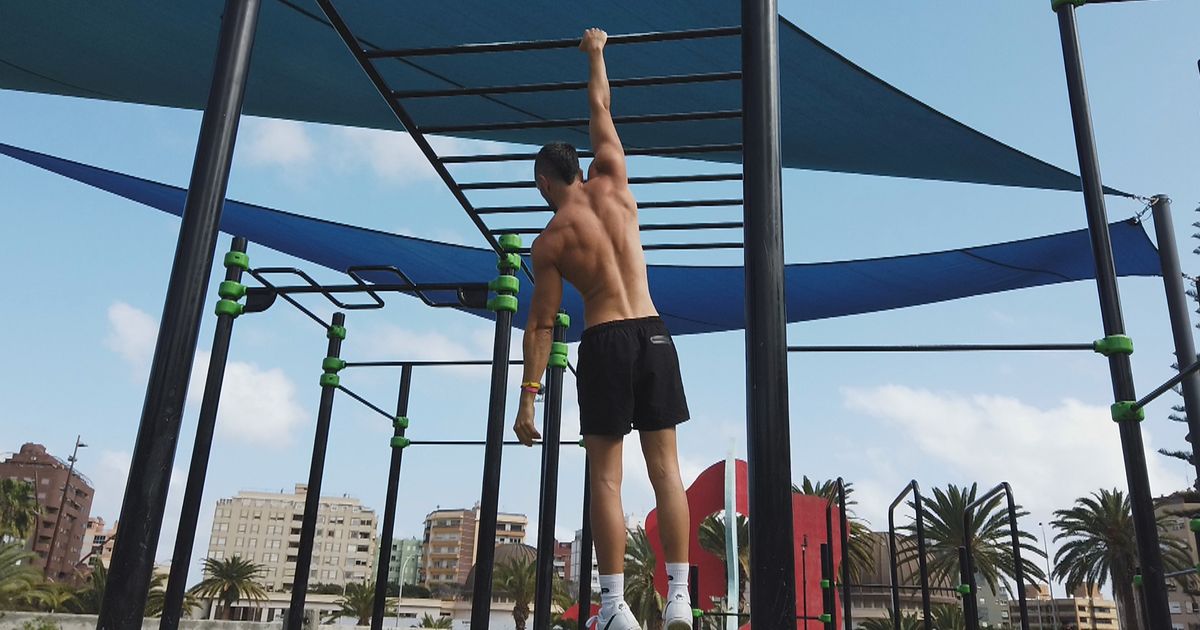
Although it's sometimes overlooked, grip strength is one of the key factors in pull-ups. Especially when we're aiming for a high number of repetitions, it becomes a decisive element.
In fact, if we look at the most extreme cases of people capable of doing a huge number of pull-ups without letting go of the bar, not even releasing one hand, like Andrei Isypov, who can perform up to 124 strict pull-ups without dropping down, we see that they themselves attribute that ability to grip strength.

As you may have already noticed, what we actually call "grip strength" when talking about pull-ups really refers to the endurance of the grip musculature, not to pure strength. The correct term is endurance, because we're referring to the ability to hang on for a long time. Strength, on the other hand, would be the ability to move a given weight, whether external or bodyweight, or to exert a specific amount of pressure in the case of grip (grip strength), at a specific moment, but it doesn't necessarily imply holding the grip for a set amount of time. This confusion has persisted over time, and you should keep it in mind while reading this article.
Personally, when I discovered Isypov's specific case, I started researching how he achieved such an incredible feat, so far removed from the records of the best calisthenics endurance athletes. His training method is based on being able to hang for as long as possible, reaching extraordinary limits, such as exceeding 15 minutes. This way, when he's doing pull-ups and hangs at the bottom, he's practically "resting," since he's not actively contracting the pulling muscles, and his grip endurance is far from even coming close to failure.
Let's quickly look at the muscles involved in the grip during pull-ups:

If you want a list of specific forearm exercises in general, not just for grip strength, check out our article on the best forearm exercises.
When we do just a few pull-ups, grip strength (really endurance) usually isn't the limiting factor, since most people are able to hang in a dead hang position for longer than it takes them to do those pull-ups.
Here we need to take into account some factors that can affect this and can be confused with grip strength:
These factors have a more direct solution that can be addressed before working on improving grip strength or endurance.
To check this, you can simply test how long you can hold a max-effort dead hang and then do a set of pull-ups to failure. See if the time you can hang for is enough to cover your pull-ups.

If you don't pass this test — if the time you can hang for is similar to how long it takes you to reach failure on pull-ups — then you do have an initial limitation, and you should start by directly working on the dead hang to increase the time you're able to hang.
On the other hand, once we're already able to do a higher number of pull-ups, grip endurance or strength does become a much more important factor. As we mentioned earlier, the ability to "rest" while hanging comes into play, letting us recover between reps and squeeze out a higher number of them.
Ultimately, our grip capacity and our pulling-muscle capacity should be treated almost separately. It should be diagnosed whether the problem is a clear lack of initial capacity when we're beginners, or a lack of optimization when we're intermediate or advanced. That said, the work to be done in both cases is similar, and we'll explain it below.

Let's look at a list of exercises to improve both your strength and, above all, your grip endurance for pull-ups.
If you still can't do your first pull-up, check out our article dedicated to achieving it.
For all of these, the idea is to do at least 3 or 4 sets per training session, trying to gradually increase your maximum time on each exercise. I'll also order them by difficulty, so once you master the first ones on the list, you can move on to the next:
Simply hang from the bar with both hands, thumb wrapped underneath, and hold for as long as possible. You can vary between pronated, neutral, and supinated grips, both to add variety to your training and to build specific endurance for each type of pull-up.
Same as the previous exercise, but letting your weight shift slightly onto each hand, alternately, without letting go of the other. Every so often, shift your bodyweight toward one hand and hold there, then switch to the other hand when you get tired.
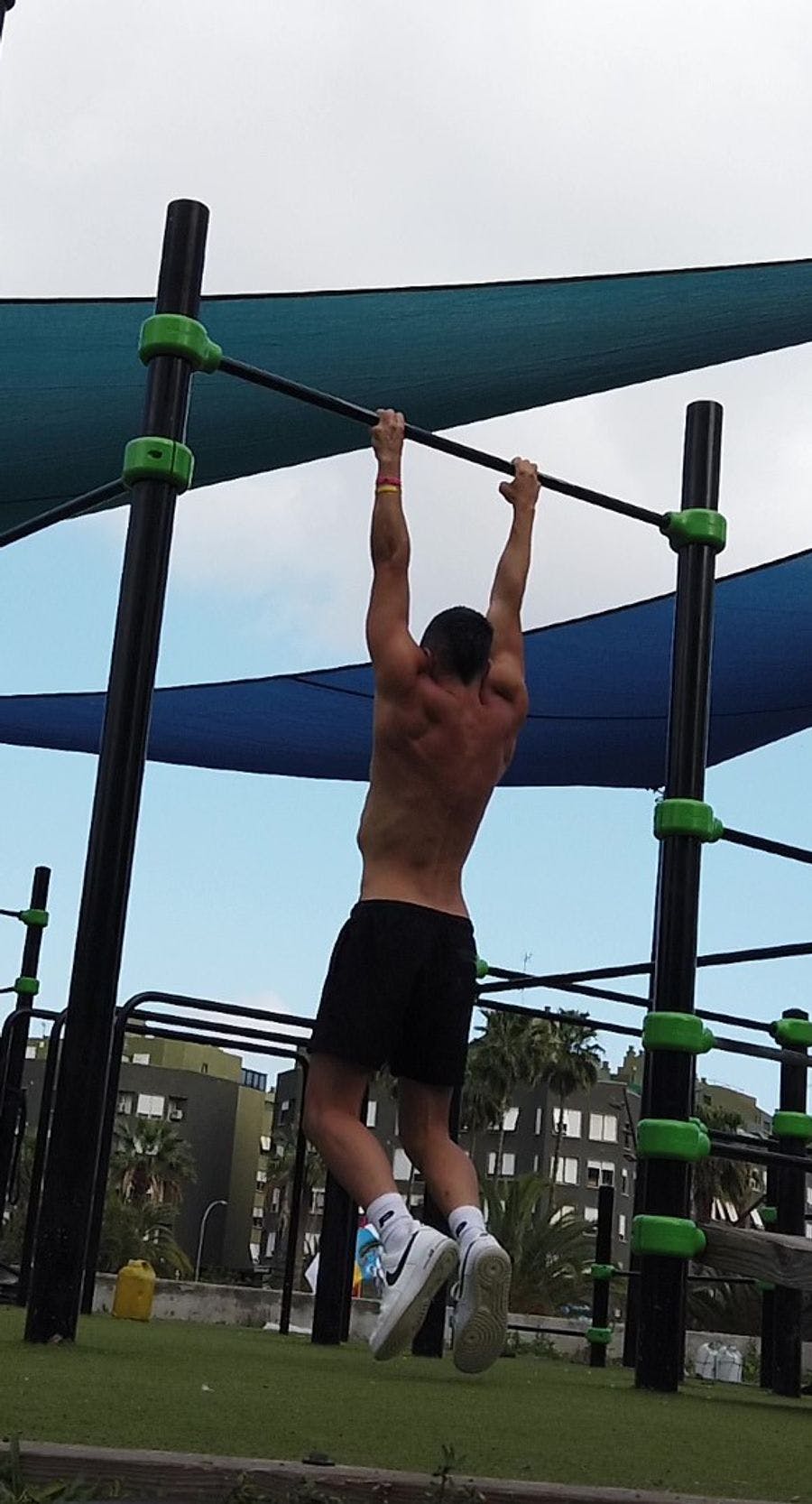
Instead of hanging with your whole hand supporting the weight, in this version you support your weight using only the four fingers (index to pinky). Keep in mind that this fingers-only version can be applied to the rest of the exercises to create a variation or increase the difficulty.
In this variation, you not only shift your weight onto one hand but actually let go of the other hand for as long as you can. Then, just as you're about to fall, place your hand back on the bar and switch to the other side.
Hang a towel from the bar and grip it for a set amount of time. This makes gripping considerably harder and forces you to work your grip muscles much more intensely.
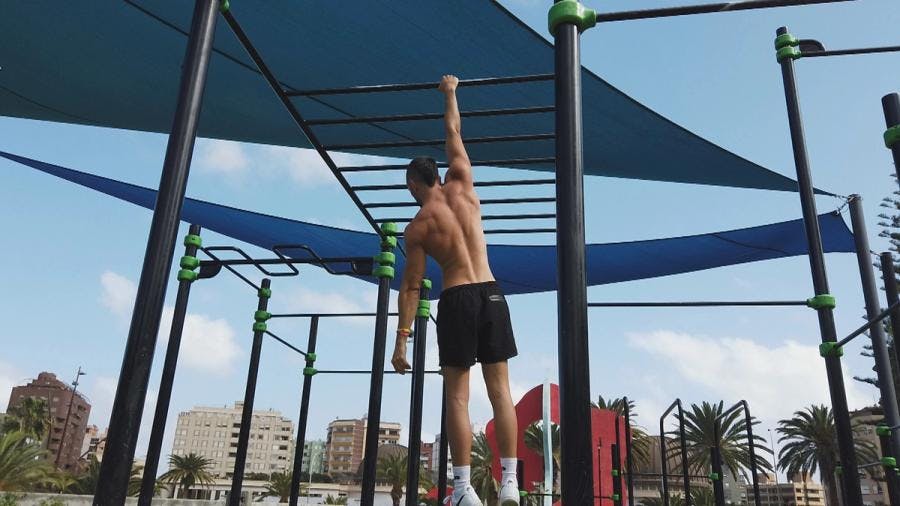
In this variation, you hang directly with one hand and hold for as long as possible without any help from the other hand. Do several sets with each hand.
The most common mistake is not training grip specifically, but instead letting it get stronger merely as a byproduct of doing pull-ups and other exercises that involve it. The quickest fix, obviously, is to add some of the exercises we've covered in this article.
This mistake is quite common among people who train at the gym: using straps for exercises that involve grip strength, and therefore training it much less and becoming dependent on this tool.
As a result, when they hang without straps, they feel insecure and feel like their grip fails much sooner. In my opinion, straps should be a resource for specific cases, in sets of certain specific exercises, but they shouldn't be a resource used in every exercise all the time, since that causes the grip to become very weak with very little endurance.
Another fairly common mistake is not using chalk, or training on a bar that's too thick, slippery, unstable, or too thin — and thinking the problem is that your grip strength or endurance is failing, when in reality the problem comes from the bar itself or from having sweaty hands and not using chalk.
Another very common mistake, especially among people who train at the gym, is leaving pull-ups for the end of the routine, when their forearms are already very tired and their grip is very weak.
Obviously, if at that point you do pull-ups and your grip fails, you shouldn't think it's because you have a weak grip or low endurance, because in reality, the problem is that you're coming from a routine in which you've already completely exhausted your grip muscles, so it's normal that you can't hold on for very long.
One of the questions I get asked most is how long it takes to notice real improvements in grip. The good news is that, unlike other muscle groups that require months to see significant changes, grip tends to respond relatively quickly if you put in consistent work.
Generally speaking, you can expect visible changes as early as the first 2-3 weeks, especially if you're starting from a low level. At first, you'll notice you can hold a dead hang longer with barely any conscious effort, simply because your nervous system is adapting and recruiting the involved muscles more efficiently.
For a more consolidated improvement — one that lets you notice the difference directly in your pull-ups (more reps, less of a "my hand is about to slip" feeling) — the realistic range is 4 to 8 weeks of consistent work. This doesn't mean you stop progressing after that point; rather, it's the period in which you start to see tangible results, not just subjective feelings of improvement.
As with any tendon adaptation, be patient: tendons and ligaments adapt more slowly than muscle, so even if you feel like your grip "explodes" in strength during the first few weeks, the structural base needs time to consolidate.
This is where a lot of people make mistakes:
First: grip work should go at the end of the session, never at the beginning. If you do it before your pull-ups or your pulling workout, you'll arrive with pre-fatigued forearms and unnecessarily limit your performance on the main exercises. Save it for the end, once you've already completed the strength and technique work you actually want to prioritize.
As for frequency, there's no need to obsess over it. 2-3 times a week is more than enough to generate progressive adaptation. It's not a muscle group that needs daily training, and in fact, training it every day can be counterproductive.
And here's the most important point: don't overload the tendons. Grip strength largely depends on tendon structures that adapt much more slowly than muscle, so if you notice persistent discomfort (not normal training fatigue, but joint or tendon pain), that's a sign you've overdone it. Increase difficulty or volume progressively, never in big jumps from one week to the next.
Let's look at a practical example of how to structure a complete calisthenics grip training session, following the progression we covered earlier:
Sample routine (2-3 times per week, at the end of your workout):
As you progress, you can start swapping in or combining exercises from the earlier list (towel dead hang, one-arm dead hang, alternately releasing hands) to keep challenging your grip without plateauing.
This type of calisthenics grip training doesn't require any additional equipment beyond a bar and, optionally, a towel or some chalk, which makes it perfectly accessible both at home and at the park.
As we've seen throughout this article, grip is a fully trainable quality using simple exercises that don't require any complicated equipment. The dead hang, in its various forms, is the foundation on which to build this capacity, and with 4-8 weeks of consistent work, you should already notice a clear change both in your hanging endurance and in your pull-up performance.
Remember that grip isn't an isolated element — it's part of your overall development in calisthenics. If you want to keep more structured track of your pull-up progress and your other pulling exercises, on Calisteniapp you can find routines and tools designed specifically for that.
By Yerai Alonso
Personalisierter Test
Beantworte 7 kurze Fragen und wir empfehlen dir das Programm, das am besten zu dir passt.

Yerai Alonso
Cofundador de Calisteniapp, referente en calistenia y el street workout en Español. Con más de una década de experiencia, es creador de uno de los canales de YouTube más influyentes del sector. Autor del libro La calle es tu gimnasio, campeón de Canarias y jurado en competiciones nacionales e internacionales.
Lerne alles, was du über Calisthenics wissen musst
Discover the best glute exercises in calisthenics to train at home without weights. Glute bridge, isometric variations, progressions, and stretches.

Discover what foods to eat to gain muscle while training calisthenics. A complete list of proteins, carbohydrates, and healthy fats with examples and practical tips.
Discover the best calf exercises in calisthenics to train at home without equipment. Standing calf raises, single-leg, elevated, and progressions.