Glute Exercises in Calisthenics: The Complete No-Equipment Guide
Discover the best glute exercises in calisthenics to train at home without weights. Glute bridge, isometric variations, progressions, and stretches.
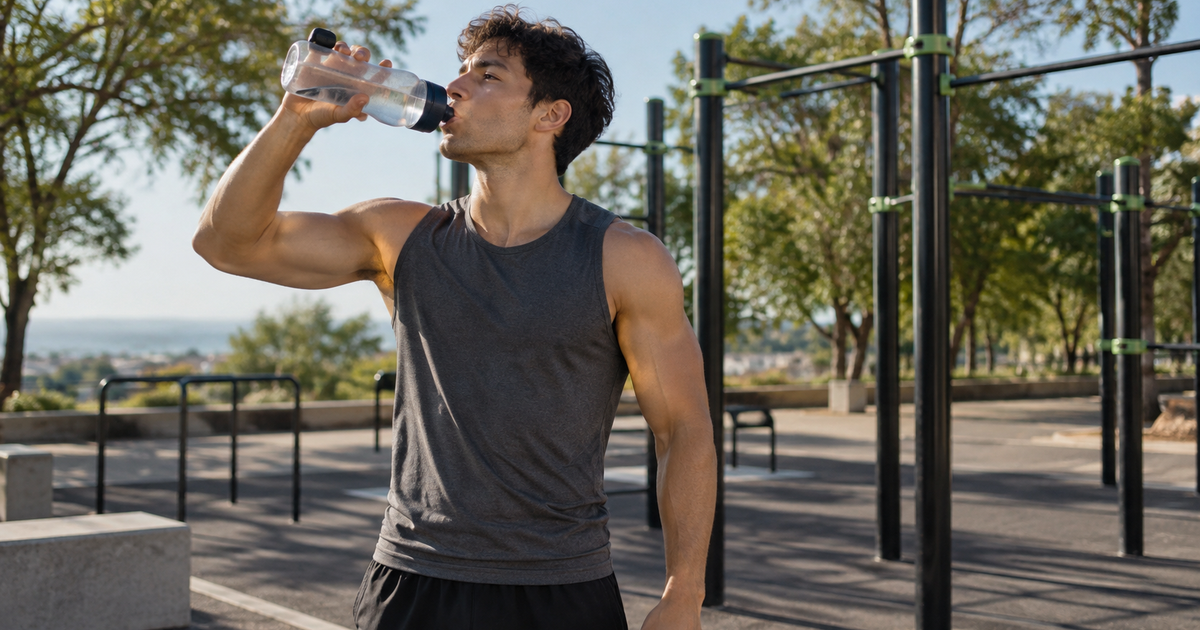
Hydration in calisthenics is a performance factor just as important as nutrition, although it often receives less attention. Maintaining a good hydration status is essential for training under good conditions, since even mild dehydration can negatively affect strength and endurance and, as a result, athletic performance.
However, water needs are not the same for everyone. The duration and intensity of the session, the temperature, the humidity, or how much you sweat can considerably change the amount you need. That is why, in this article, we will look at how much water to drink when training, how to adjust the amount to your needs, and when to drink before, during, and after a calisthenics session.
Water makes up an important part of the body and of muscle tissue itself. It is involved in numerous processes related to exercise, from regulating body temperature to transporting nutrients and maintaining blood volume.
During training, we lose water mainly through sweat. If these losses are not properly replaced, dehydration can occur and cardiovascular and heat stress can increase, especially when training in hot conditions. A significant loss of fluid can compromise physical performance.
In calisthenics, this can translate into a greater perception of effort, earlier onset of fatigue, and difficulty maintaining performance as the session progresses. In addition, proper hydration is also part of the post-exercise recovery process.
Therefore, the relationship between hydration and athletic performance is not simply about drinking a lot of water, but about maintaining a balance between the fluid we lose and the fluid we take in.
As a general guideline, an approximate intake of 30-35 ml of water per kilogram of body weight per day can be used as a starting point. However, this figure should not be understood as an exact amount that works for any person.
For example, for a person weighing 70 kg:
This would amount to approximately 2.1-2.45 liters per day as an initial reference. From there, intake should be adjusted taking into account exercise and individual losses.
If you are wondering how much water to drink per day when you exercise, the answer will depend especially on how much you sweat. A short, low-intensity session performed in a cool environment does not create the same needs as a long, demanding workout in the middle of summer.
The duration of the workout, its intensity, ambient temperature and humidity, the clothing worn, and individual adaptation to heat also play a role. That is why current sports hydration recommendations insist on individualizing the strategy instead of establishing an identical amount for all athletes.
A practical way to better understand your needs is to weigh yourself before and after training. Changes in body weight, together with the amount of fluid you drink, can help you estimate how much fluid you lose during a session and progressively adjust your hydration.
You do not need to wait until the end of the session to think about hydration. Arriving well hydrated, drinking when necessary during the workout, and replacing part of the fluid lost afterwards makes it possible to spread your intake throughout the day and avoid having to drink large amounts all at once.

The goal of hydrating before training is to start the session in a good state of hydration.
As a practical reference, you can drink approximately 400-600 ml of fluid during the 1-2 hours before training, adjusting the amount to your individual needs and avoiding drinking large volumes right before starting.
You can also use some simple signals to assess your everyday hydration. The sensation of thirst, how often you urinate, urine color, and changes in body weight can provide useful information when interpreted together.
The idea is not to drink as much as possible before training, but to arrive at the session properly hydrated.
During the session, the goal is to limit excessive fluid losses without falling into the opposite extreme of drinking more than necessary.
A simple strategy is to take regular sips approximately every 15-20 minutes, especially when sessions are long, intensity is high, or you are training in hot environments.
There is no hourly amount that is right for absolutely everyone. Sweat rates vary widely between people and also change depending on environmental conditions and the type of training.
That is why observing how much you sweat and how your weight changes before and after similar sessions can help you develop a much more precise hydration strategy than simply forcing yourself to finish a given bottle.
In addition, drinking more does not necessarily mean better hydration. Excessive fluid intake can cause hyperhydration and, in certain situations, contribute to a dangerous drop in blood sodium concentration.
After the session, the goal is to progressively replace the fluid lost through sweat.
If the workout caused significant losses, weighing yourself before and after can serve as a reference. In most situations, it is not necessary to replace all the fluid immediately: rehydration can take place progressively through drinks and food over the following hours.
When rapid recovery is needed, for example if there is little time between two sessions, the strategy can be more specific. The IOC consensus states that, in most situations, replacing around 100-120% of the body mass lost through fluids and food can be enough, while more aggressive strategies are reserved for specific situations.
Hydration is part of recovery, but it is not the only factor involved. If you want to dive deeper into post-workout nutrition specifically, you can check out our guide on what to eat after a calisthenics workout.
When we sweat, we lose not only water but also electrolytes. However, not all of them are lost in the same amounts, nor do they all need to be specifically replaced during exercise. Sodium is the main electrolyte lost through sweat and, therefore, the one with the greatest relevance when planning a sports hydration strategy.
Although small amounts of potassium and magnesium are also lost, these losses are considerably smaller and, under normal conditions, can be covered through an adequate diet. For this reason, a sports electrolyte drink does not need to contain large amounts of potassium or magnesium to be useful during training.

In fact, in relatively short sessions, with moderate temperatures and without especially high sweat rates, it is generally not necessary to resort to electrolyte drinks. Water, together with an adequate diet throughout the day, is usually enough.
Sodium intake can become more important when:
In these cases, adding sodium to fluids or replacing it afterwards through food can help restore losses and promote the retention of the fluid consumed.
Therefore, talking about "replenishing electrolytes" does not necessarily mean that sodium, potassium, and magnesium must be supplied in similar amounts. In the context of hydration during exercise, sodium is the electrolyte that deserves the most attention, while losses of potassium and, especially, magnesium are much smaller and are usually covered by the diet.
The body can offer some clues that help detect that your fluid intake may be insufficient. Among the most common are:
Urine color can be a simple tool, but it should not be used in isolation. The NATA recommends combining different indicators such as thirst, weight changes, urination frequency, and urine color to obtain a more useful reference of hydration status.
Muscle cramps are also often automatically associated with dehydration or a lack of electrolytes, but their origin can be multifactorial. For this reason, having cramps does not necessarily mean that the problem is simply not having drunk enough water.
One of the most frequent mistakes is not paying attention to hydration until you are very thirsty. If you know you are going to do a long, intense session, or one in very hot conditions, it is more practical to start the workout properly hydrated and have fluid available during the session.
Another mistake is not drinking anything during prolonged workouts, especially when sweat rates are high. The greater the losses, the more important it is to have a strategy adapted to them.
At the opposite extreme is drinking too much water. Trying to prevent dehydration by consuming amounts far greater than your losses offers no advantages and can be harmful. Current recommendations state that a person who starts exercise properly hydrated should not gain body weight during training as a result of excessive fluid intake.
It is also common to ignore heat and humidity. Two identical workouts may require very different hydration strategies depending on environmental conditions. In hot environments, sweating increases and, with it, water and electrolyte losses.
Hydration is a pillar of athletic performance just as relevant as other aspects of preparation. Maintaining a good hydration status helps you face training, manage the losses caused by sweat, and promote proper recovery afterwards.
There is, however, no perfect amount of water for everyone. Using an initial reference and then adjusting it according to your weight, how much you sweat, the duration and intensity of the workout, and environmental conditions is a much more useful strategy than trying to hit a rigid number every day.
Drinking regularly, arriving well hydrated to your sessions, and learning to recognize signals such as thirst, changes in body weight, or the color and frequency of your urine will allow you to better adapt your hydration to your needs.
With Calisteniapp, you can keep structuring your workouts and progressions while incorporating hydration habits adapted to the demands of each session.
Quiz personnalisé
Répondez à 7 questions rapides et nous vous recommanderons le programme le plus adapté.
Apprenez tout ce que vous devez savoir sur la calisthénie
Discover the best glute exercises in calisthenics to train at home without weights. Glute bridge, isometric variations, progressions, and stretches.
Discover what foods to eat to gain muscle while training calisthenics. A complete list of proteins, carbohydrates, and healthy fats with examples and practical tips.
Discover the best calf exercises in calisthenics to train at home without equipment. Standing calf raises, single-leg, elevated, and progressions.