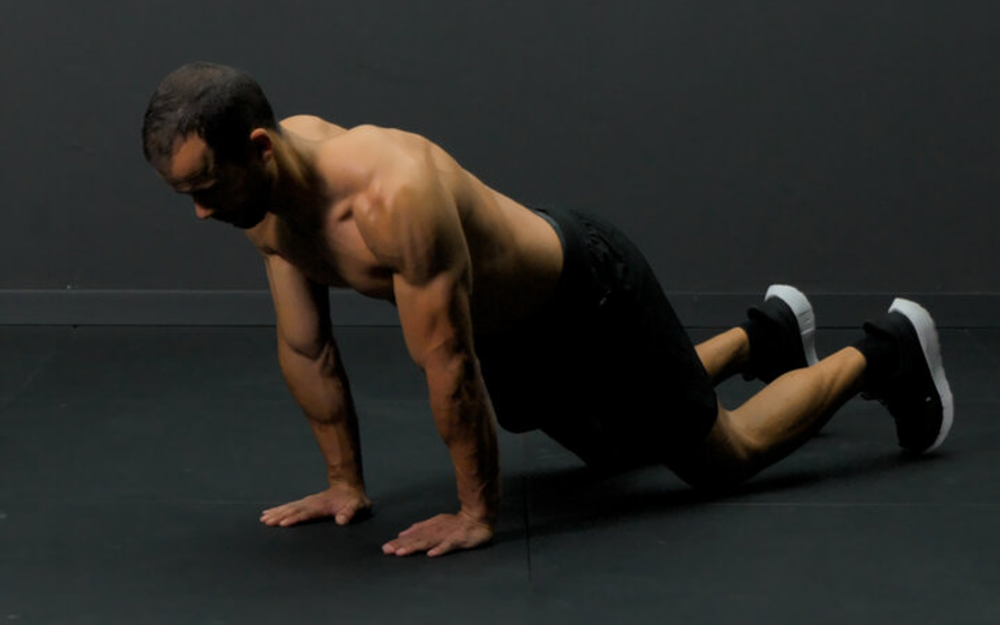
Wrist Exercises for Calisthenics: Mobility and Warm-Up Without Equipment
Discover the best wrist mobility and warm-up exercises for calisthenics. Rotations, progressions, and tips to protect your wrists during handstands and push-ups.
Discover what a calorie deficit is, how to calculate it based on your activity level, and how to apply it if you train calisthenics to lose fat without losing muscle.

If your goal is to lose fat, there's a fundamental principle you need to know: the calorie deficit. Although "fat-burning" foods, supplements, or miracle methods are often talked about, the reality is that body fat loss depends primarily on maintaining a negative energy balance for a sufficient amount of time.

Now, running a calorie deficit doesn't mean going hungry, eliminating entire food groups, or obsessively counting calories every day. In fact, when applied incorrectly, it can affect performance, increase fatigue, and contribute to muscle loss.
In this article, you'll discover what a calorie deficit is, how to calculate it step by step, and how to apply it if you also train calisthenics, so you can lose fat sustainably while maintaining your strength and muscle mass.
When we talk about a calorie deficit, we mean consuming fewer calories than your body burns throughout the day.
When this happens, the body needs to source energy from somewhere else to cover its needs. Part of that energy comes from the body's reserves, mainly from fat tissue.
That's why a calorie deficit is the main mechanism that allows you to lose body fat. Without it, fat loss becomes extremely difficult, regardless of what type of diet you follow.

In other words, if you're wondering what a calorie deficit is, the simple answer is this: a situation in which your body burns more energy than it takes in through food.
Every day your body uses energy to maintain vital functions, digest food, move, train, and carry out any kind of physical activity.
The sum of all that energy expenditure is known as total daily energy expenditure, or TDEE (Total Daily Energy Expenditure).
This expenditure is made up of:
When calories consumed are lower than that total expenditure, the body has to draw on its energy reserves.
However, it's important to understand that the body doesn't lose exclusively fat. That's why how you apply the deficit will make the difference between losing mainly fat or also losing muscle mass and performance.
Basal metabolism represents the calories your body needs to stay alive at rest.
One of the most widely used formulas today is the Mifflin-St Jeor equation:
-For men:
BMR=(10 x weight) + (6.25 x height cm)-(5 x age) +5
-For women:
BMR=(10 x weight)+(6.25 x height cm)-(5 x age)-161
Example, man
BMR ≈ 1,700 kcal/day.
Example, woman
BMR ≈ 1,295 kcal/day.
This figure only represents the energy needed at rest.
Once you have your basal metabolic rate, you multiply it by an activity factor.
Practical example
A 75 kg man with a BMR of 1,700 kcal who trains calisthenics 5 days a week:
1,700 × 1.55 = 2,635 kcal
His total daily energy expenditure would be approximately 2,635 kcal.
Between 300 and 500 kcal below daily expenditure.
Following the example above:
TDEE: 2,635 kcal
Deficit of 400 kcal
Daily target: 2,235 kcal
This tends to be the most recommendable approach for most people who train.
Between 500 and 750 kcal below expenditure.
Although it allows you to lose weight faster, it increases the risk of:
For this reason, it usually isn't the best strategy for athletes or people who train calisthenics frequently.
One of the biggest concerns during a fat loss phase is preserving muscle mass.
Scientific evidence shows there are three factors that are especially important:
Scientific reviews suggest that protein needs increase during a calorie deficit.
For people who do strength training, roughly 1.6 to 2.2 g of protein per kilogram of body weight per day is typically recommended.
For example:
Calisthenics acts as a signal for the body to preserve muscle mass.
Drastically cutting back on training during a fat loss phase increases the risk of losing muscle.

The bigger the deficit, the harder it becomes to maintain performance and muscle mass.
In most cases, losing fat more slowly tends to produce better long-term results.
Approximate deficit:
-Advantages:
Ideal for people who are relatively lean or who prioritize performance.
Approximate deficit:
-Advantages:
Approximate deficit:
Advantages:
Drawbacks:
This tends to be useful only in specific situations and for limited periods.
There's no single perfect diet, but there are some principles that tend to work well.
Some examples:
Protein helps preserve muscle mass and increases satiety.
Carbohydrates are the main energy source for intense training sessions.
Some options:
Eating them before and after training can support performance and recovery.
Fats are necessary for multiple physiological functions, including hormonal function.
Recommended sources:
Vegetables, fruits, and fiber-rich foods let you eat more volume with fewer calories, making it easier to stick to your plan.
A calorie deficit shouldn't become a permanent strategy. Its duration will depend on your starting point, your body fat percentage, and your individual goal.
In general terms:
Some signs that may indicate the need for a pause include:
The calorie deficit is the fundamental mechanism for losing body fat. However, doing it correctly matters far more than simply eating less.
Calculating your energy needs, applying a moderate deficit, maintaining adequate protein intake, and continuing to train strength are the keys to losing fat without sacrificing muscle mass or performance.
If you also practice calisthenics, combining well-structured training with a sound nutritional strategy will let you progress more efficiently, sustainably, and healthily over the long term.
The best diet isn't the one that makes you lose the most weight in two weeks, but the one that lets you lose fat, maintain muscle, and keep enjoying the process while improving your performance.
Personalized quiz
Answer 7 quick questions and we will recommend the program that fits you best.
Learn everything you need to know about calisthenics
Discover the best wrist mobility and warm-up exercises for calisthenics. Rotations, progressions, and tips to protect your wrists during handstands and push-ups.

Find out which supplements are worth taking if you train calisthenics (and which aren’t). Creatine, protein, caffeine, and more, backed by scientific evidence.
What's new in Calisteniapp v26.9.0: community comments, a new weighted calisthenics program with RPE, and improvements to the routine builder.