Glute Exercises in Calisthenics: The Complete No-Equipment Guide
Discover the best glute exercises in calisthenics to train at home without weights. Glute bridge, isometric variations, progressions, and stretches.
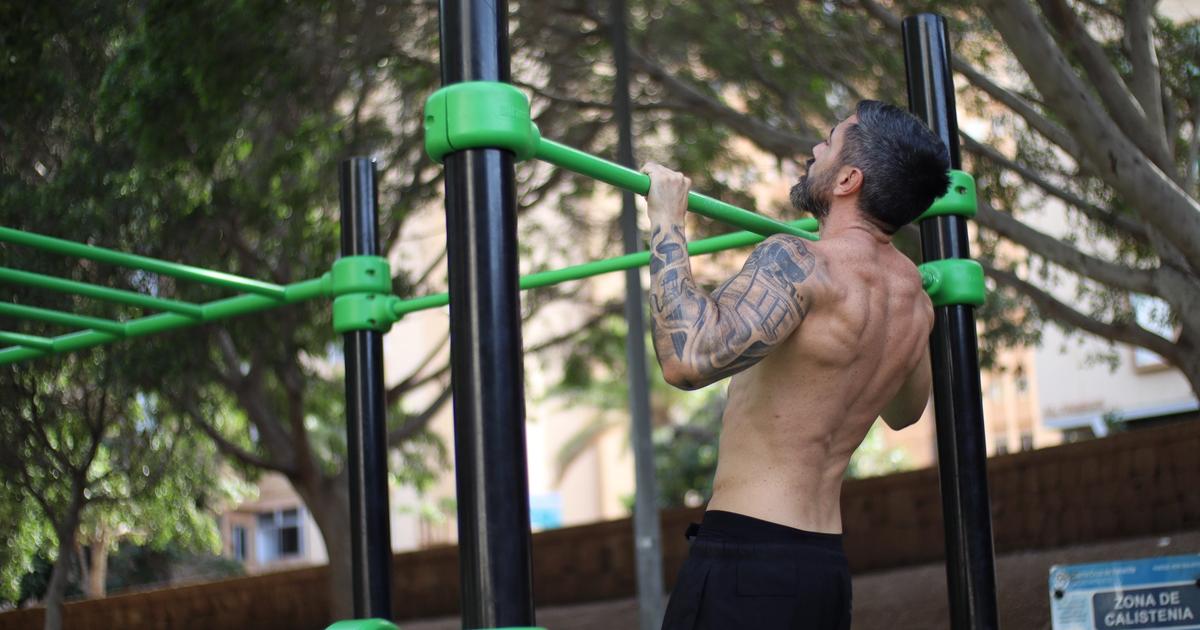
When we talk about calisthenics and strict technique (or strict reps), there are three key factors at play:
In today’s article, we’ll cover what counts as strict technique based on these factors and how to identify it in any exercise—even if you’ve never seen it before.
In other words, we’ll try to define what strict execution in calisthenics is in an objective way that can be applied to any exercise.

Before we can explain what a strict rep is, we need to be clear on how an exercise itself is defined.
The most important point is that defining an exercise means establishing a movement pattern for specific joints and, therefore, specific muscle groups. This definition is usually simple, clear, and direct. For example, a pull-up could be defined as “a vertical pull where you flex your arms to get over a bar, starting from a hanging position.”
As we can see, that definition doesn’t include anything else. There’s no mention of swinging, momentum, leg movement, or any other additions. Just hanging from a bar and flexing the arms to get over it.
The same applies to other exercises. Starting from this point, and taking into account calisthenics values such as:
We already have a foundation to define each exercise and what a strict rep looks like in each one.

Based on these concepts, we can define a strict rep in calisthenics as:
Executing an exercise in a way that adheres to its definition in the simplest and most objective way possible.
Even though this definition is short, it contains several key ideas:
The first is the definition of the exercise itself, as discussed above.
The second is the idea of simplicity. Strict form is the simplest form in the sense that it avoids adding extra movements, avoids adding momentum or swinging, avoids involving muscles that shouldn’t be part of the movement, and avoids introducing movement patterns that aren’t part of the exercise.
This is why, for example, pull-ups with knee flexion wouldn’t be strict, and push-ups with hip movement wouldn’t be strict either.
For the same reason, in pull-ups there’s no need to point your toes, as that adds unnecessary complexity. Likewise, in push-ups there’s no need to perform scapular protraction at the start or a posterior pelvic tilt.

If we define a push-up based on what we’ve explained, we can say it consists of placing your hands and feet on the ground and performing arm flexion. If we stick to that definition, a posterior pelvic tilt adds nothing and reduces simplicity.
The final concept is objectivity. This helps us define, above all, ranges of motion.
A pull-up involves going above the bar, but “above the bar” can be ambiguous. So an objective way to measure it is for the chin to clearly pass the bar without excessive neck extension, which would reduce simplicity.
In push-ups, you need to flex the arms—but how much? An objective measure would be until you reach 90 degrees of elbow flexion.
Here’s a small nuance regarding how these ranges are applied in practice. Ideally, in my experience—and as has been most successfully applied in different calisthenics competitions—you should slightly exceed this objective point.
When someone is performing continuous reps, and especially in competitions where speed matters, it can be hard for a judge or observer to clearly see whether they’re reaching 90° or falling slightly short—especially when trying to optimize for maximum reps.
When watching fast, repeated movements in real time, doubts can arise, and the athlete may fall short of full range by a few millimeters on some reps.
Therefore, in practice, the recommendation is to slightly exceed that point to ensure you’re at least reaching 90°. Similarly, in Street Lifting there’s consensus that dips should slightly surpass 90 degrees so that the rear deltoid drops below the elbow.
By applying these concepts, we can reach consensus definitions of what strict reps look like across exercises. Let’s look at some examples:
Simple definition: Hang from a bar and flex your arms to get over it.
Strict rep characteristics and clarifications: Hanging, in a simple and objective sense, means a full dead hang—not “almost hanging” with slightly bent elbows. Getting over the bar means the chin clearly passes it without adding neck extension or unnatural movement. Hanging and flexing the arms doesn’t imply swinging, bending the knees, excessively bracing the core, or pointing the toes. From the lats down, the body can remain fully relaxed, aside from minimal stabilization. Hanging from a bar also doesn’t imply crossing the legs.
For more details, check my article on “the perfect pull-up.”
Simple definition: On parallel bars, flex the arms and return to the starting position.
Strict rep characteristics and clarifications: The descent goes to 90° (or slightly beyond). Both the starting position and the lockout must be full lockout—not “almost locked out.” The natural descent involves slight hip flexion; without it, shoulder positioning becomes unnatural and chest engagement suffers. However, it doesn’t involve exaggerated hip flexion that turns the rep into a hinge. It also doesn’t imply excessive forward lean, swinging, knee flexion, or crossing the legs.
You can find more information about dips in this article.
Simple definition: Face down on the floor with hands and feet as points of contact, flex the arms and return to the starting position.
Strict rep characteristics and clarifications: Start with elbows locked, descend to 90° or slightly beyond. The definition doesn’t include hip movement, crossing the legs, excessive spinal arching, or head movement.
For more information, check my article on perfect push-ups.
Simple definition: From a hanging on a bar, perform an explosive pull-up to get over it and finish supported on the bar with hips in contact and elbows extended.
Strict rep characteristics and clarifications: A slight initial swing is necessary to get over the bar, but there’s no need to arch the back or kick the legs. Start and finish with elbows locked—not “almost locked.” It also doesn’t involve leading with one elbow or bending the knees.
If you want to learn more, check my article on improving your muscle-up.

Simple definition: From a standing position, flex the knees and hips and return to the starting position.
Strict rep characteristics and clarifications: For an objective standard, descend to 90° knee flexion (slightly beyond for clarity). Standing implies fully extended legs—not “almost extended.” The definition doesn’t include lifting the heels or excessive rounding/arching of the back.
Simple definition: With hands on the ground, achieve a vertical, balanced position perpendicular to the floor.
Strict rep characteristics and clarifications: The definition implies a straight vertical line—not an arched back. Alignment of arms, torso, legs, and pointed feet defines that verticality. It doesn’t include bending the knees or walking on the hands.
More info in my article on the straight handstand.
Simple definition: Hanging from a bar, hold a horizontal position with the torso and legs facing up, parallel to the ground.
Strict rep characteristics and clarifications: Being parallel means the hips must be high enough to align torso and legs. The definition doesn’t include bent arms.
Simple definition: Hanging from a bar, hold a horizontal position with the torso and legs facing down, parallel to the ground.
Strict rep characteristics and clarifications: Parallel to the ground doesn’t imply an arched back, dropped hips, or bent knees.
I hope these examples make the concept clear and show how to apply it to any exercise.
When putting this into practice, the athlete can always ask whether a technical aspect adheres to the exercise definition or adds something unnecessary.
The same applies to range of motion—whether it’s complete, objective, and aligned with the definition.
A practical way to improve is to record yourself performing the exercise from the angle that best shows the parameter you want to fix, and identify any flaws to work on.

In general, strict reps should be the default. They ensure effective, safe training aligned with calisthenics values.
However, there are cases where using “non-strict” technique can be useful—either by shortening the range of motion or adding specific technical elements. For example:
These are just a few examples of the many situations where non-strict technique can be used intentionally for a specific goal.
In many cases, these uses—especially when intentional—are considered exercise variations. For example, partial pull-ups are a variation, not “bad technique.” A different case—also common—is claiming a max pull-up record while using poor technique or partial range; that would clearly be incorrect.

In calisthenics, strict technique is a defining element of the discipline. We must understand how to define it and how to execute it.
If we want to compete, set records, or even track progress against our own past performance, it must be done under a clear, objective, standardized technique.
And if we choose to use non-strict technique, we should be fully aware of why.
In some exercises or specific technical aspects, there may be small doubts or nuances about what counts as strict. But at the very least, we need clear, well-defined, and applicable foundations to work from. Hopefully, this article helps with that.
In our Calisteniapp app, you’ll find Training Programs, personalized EVO Routines, 21-day challenges, and much more to help you train—whatever your goal. Check it out.
By Yerai Alonso
Quiz personalizado
Responda 7 perguntas rápidas e vamos recomendar o programa que melhor se adapta a você.

Yerai Alonso
Cofundador de Calisteniapp, referente en calistenia y el street workout en Español. Con más de una década de experiencia, es creador de uno de los canales de YouTube más influyentes del sector. Autor del libro La calle es tu gimnasio, campeón de Canarias y jurado en competiciones nacionales e internacionales.
Aprenda tudo o que precisa saber sobre calistenia
Discover the best glute exercises in calisthenics to train at home without weights. Glute bridge, isometric variations, progressions, and stretches.

Discover what foods to eat to gain muscle while training calisthenics. A complete list of proteins, carbohydrates, and healthy fats with examples and practical tips.
Discover the best calf exercises in calisthenics to train at home without equipment. Standing calf raises, single-leg, elevated, and progressions.