Wrist Exercises for Calisthenics: Mobility and Warm-Up Without Equipment
Discover the best wrist mobility and warm-up exercises for calisthenics. Rotations, progressions, and tips to protect your wrists during handstands and push-ups.
Discover the best calisthenics biceps exercises. Learn how to build arm strength without weights using bodyweight movements, effective progressions, and expert technical tips.
The biceps is one of the most sought-after and trained muscles in calisthenics, but it is also one of the ones that generates the most questions. Can you really develop your biceps training only with bodyweight? Which exercises work it best? Is it necessary to "isolate" it, or is doing pull-ups enough? In this article, you will learn how the biceps works from a biomechanical point of view and how it is activated in the main calisthenics exercises.
Throughout the text, we will analyze which movements work the biceps directly and indirectly, how to train it according to your level, what errors to avoid, and how to correctly integrate it into your routine. Furthermore, we will see why gymnasts and calisthenics athletes usually develop such strong arms and which exercises are most effective for gaining strength and hypertrophy without the need for weights.

The technical name for this muscle is biceps brachii, as it is made up of two heads: a long head and a short head, and it is located in the arm (brachial region). However, from here on, we will simply call it the biceps.
This muscle originates at the scapula, crosses the shoulder joint, descends along the humerus, and crosses the elbow joint, inserting into the forearm bone known as the radius.
Understanding this anatomy is very important, as it allows us to understand how the biceps functions and, consequently, identify the best exercises for training it in calisthenics.

Since the biceps is located in the anterior region of the arm, crosses the elbow joint, and inserts into the radius, its primary function is to lift the forearm. This movement is known as elbow flexion. However, the biceps is not the only muscle that performs this function; the brachialis and brachioradialis also participate in elbow flexion.
This is the movement performed in biceps curls and multi-joint exercises, such as lat pulldowns and rows.
Due to its insertion point on the radius, the biceps is also responsible for rotating the forearm outward so that the palm of the hand faces upward. This movement is known as forearm supination. In addition to the biceps, another muscle that participates in this function is the supinator muscle.
For this reason, it is generally recommended to perform the aforementioned exercises with a supinated grip, as this allows for greater emphasis on the biceps.

Although the biceps also crosses the shoulder joint, its function in this joint remains a somewhat controversial topic (1). However, some research suggests that the long head of the biceps does play a role as an assistant in shoulder flexion during the first 30 degrees of arm elevation, especially when the elbow is extended (2).
This is the movement performed in exercises such as front raises or the Zanetti press with dumbbells.

To work the biceps (and, in general, any muscle), there must be a force or resistance acting in the opposite direction of the movement the muscle is trying to perform. For example, in a biceps curl, the arm moves upward; therefore, there must be a resistance acting downward, which in this case is the weight of the dumbbell due to gravity.

Without getting into overly technical explanations, what determines how hard a muscle must work in an exercise is the distance between the joint and the resistance. Holding a dumbbell with the elbow at 90° is not the same as doing it with the elbow near 0°. In the second case, the distance is shorter, and therefore, the force the biceps must apply will also be lower.

Note: This distance is known as the moment arm and, more precisely, it is the perpendicular distance from the joint to the line of force of the resistance.
To train the biceps, it is not necessary for the resistance to come from an external weight. You can also move or lift your body weight using a point of support. In this case, the resistance corresponds to the force acting in the opposite direction to the force applied by the hand, which is in contact with the support point (Newton's Third Law).


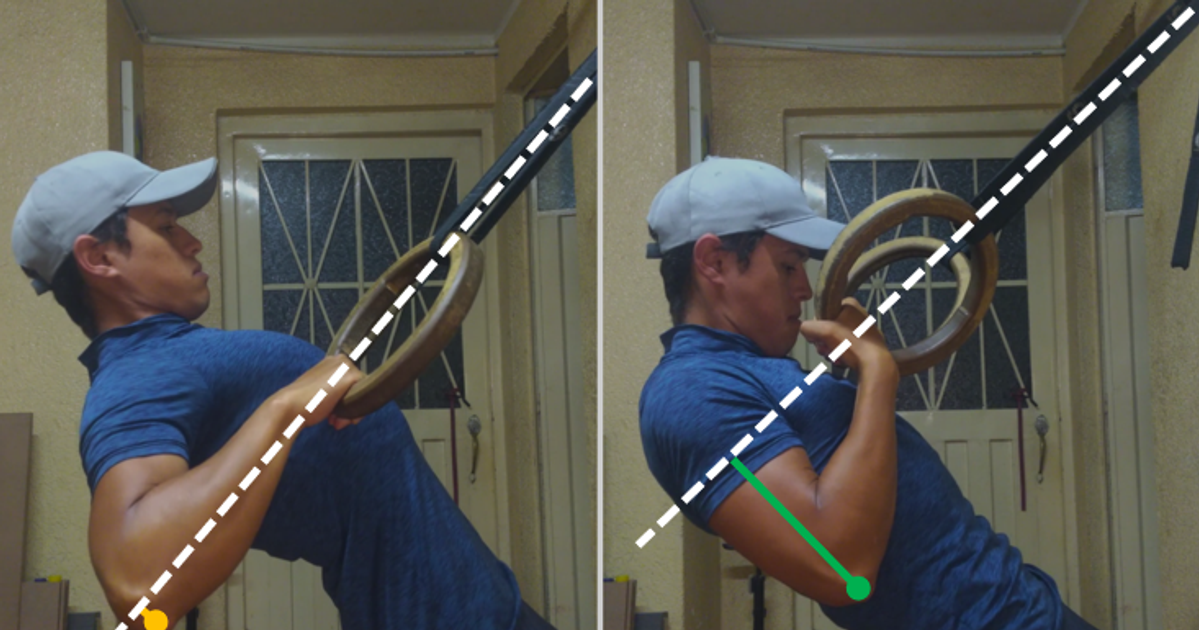
The chin-up is a great exercise for the biceps; however, something that is not always considered is that technique greatly influences the level of activation of this muscle. Therefore, if your goal is to emphasize biceps work, it is advisable to make some technical adjustments:
The goal of these changes is to bring the elbows in front of the body. In this way, elbow flexion is emphasized, and therefore, the biceps will take on a greater role.


Australian chin-ups are also an excellent exercise for the back and biceps, so the idea is to apply the exact same technical adjustments. In this case, there is also the advantage of being able to pull the bar or rings higher, to neck level. This allows for even more emphasis on the biceps compared to standard pull-ups.

If you want to explore more about this exercise, you can read our article: Why AUSTRALIAN PULL UPS are the most important exercise in CALISTHENICS

The ring biceps curl is like Australian chin-ups but "isolating" the muscle completely, as the goal is to bring the rings (or bar) to head level or above. Therefore, the movement will be exclusively at the elbow; the shoulder will remain in the same position throughout the range of motion, without extending or flexing.

Ring pelicans also consist of performing a biceps curl, but in this case, the body is facing down; therefore, the hands remain behind the body. As in the previous case, the idea is for the movement to occur exclusively at the elbow, without flexing or extending the shoulder.
In both this exercise and the previous one, the difficulty can be modified by changing the inclination of the body. The closer the body is to a horizontal position, the more difficult the exercise will be.

The Hefesto can be understood as a variant of the pelican, but with the entire body suspended in the air, which considerably increases its difficulty. This exercise requires special care because, in addition to the high load the biceps receives, it also demands good shoulder mobility. Therefore, proper preparation is fundamental; otherwise, the risk of injury increases.
Here you can look at the tutorial for this exercise, in case you want to train it correctly: Hefesto tutorial, complete guide to achieve it from scratch

Now we are going to look at two exercises that generate quite a bit of confusion in the world of calisthenics. When talking about biceps training, it is usually associated with curls and pull or back exercises, like all those mentioned so far. However, this does not always have to be the case.
To better understand this point, let’s analyze the following example: the biceps curl with arms elevated (or a preacher curl). In this exercise, unlike the conventional biceps curl, the greatest tension is felt when the elbow is fully extended, isometrically. The explanation lies in the moment arm; in the preacher curl, due to the inclination of the arm, a moment arm exists when the elbow is extended, whereas in a conventional curl, there is practically none.

For this same reason, the biceps will be highly involved in supinated front raises. Although there is no dynamic elbow flexion movement, an isometric contraction occurs that prevents elbow extension. In this case, the biceps acts as a stabilizer in the elbow joint.
This occurs regardless of body position: whether standing or lying on a bench, the moment arm at the elbow is practically the same.

Once this principle is understood, it is easier to see that exactly the same thing happens in some calisthenics exercises. For this reason, the biceps has high activation in exercises like the planche, maltese, back lever, and all their progressions and variants.

This includes movements like handstand presses and planche push-ups—exercises that, being pushing movements, are usually associated with triceps work, but as we saw in the biomechanical explanation, they actually work the biceps more.


As explained at the beginning of the article, the biceps also participates in shoulder flexion, especially in the initial ranges of arm elevation. For this reason, in exercises like the back lever and the maltese, the biceps works in two different ways: at the elbow level, through isometric elbow flexion (stabilization), and at the shoulder level, as an assistant in shoulder flexion.

This is one of the reasons why calisthenics athletes and gymnasts usually have such developed biceps, as they dedicate a large training volume to exercises like these, which require high biceps activation (3).

Finally, we highlight two of the most difficult biceps exercises in all of calisthenics, as, in addition to the entire load the biceps receives, these movements simultaneously demand:
Now that we have reviewed all these exercises, we are going to organize them according to each person's level. This is especially important because many of them are very technical and present a high degree of difficulty.
We already saw how body posture directly influences biceps work. Therefore, it is fundamental to maintain a good position throughout the entire range of motion. If you lose posture, the exercise is likely too advanced for your level and you are compensating to complete the rep. In that case, it is best to use a progression that allows for correct technique.
Some exercises require the use of a false grip, where the wrist rests on the bar or rings. If this grip is lost, force application is compromised and the exercise becomes much harder or even impossible.
Several of these exercises subject the biceps to a considerable load in demanding positions. It is important to avoid jerky movements, especially in exercises where the arms remain straight and the biceps acts primarily as a stabilizer.
Focus on basic patterns: pulls and pushes. The biceps already receives a stimulus through vertical pulls (chin-ups) and horizontal pulls (Australian chin-ups).
For those focusing on advanced skills like Hefesto or Full Planche, specific programming is required. We recommend the specialized programs available in the Calisteniapp app.
Does calisthenics make your biceps grow? Yes. Muscle growth depends on mechanical tension, regardless of whether it comes from an external load or your own body weight. The most important thing is to work close to failure.
Which grip works the biceps the most? The supinated grip (palms facing up) puts the most emphasis on the biceps. However, for overall development, it is best to vary your grips.
Can you train biceps at home without weights? Of course. You can perform rows and curls using rings, a TRX, a towel, a table, or any other sturdy material you have at home.
Remember that in Calisteniapp, you can find routines and programs to train your biceps and other muscle groups, adapted to your level and equipment. Download it and start training in a structured way.
Images:
By: Alex Belt
Personalized quiz
Answer 7 quick questions and we will recommend the program that fits you best.
Learn everything you need to know about calisthenics
Discover the best wrist mobility and warm-up exercises for calisthenics. Rotations, progressions, and tips to protect your wrists during handstands and push-ups.
Find out which supplements are worth taking if you train calisthenics (and which aren’t). Creatine, protein, caffeine, and more, backed by scientific evidence.
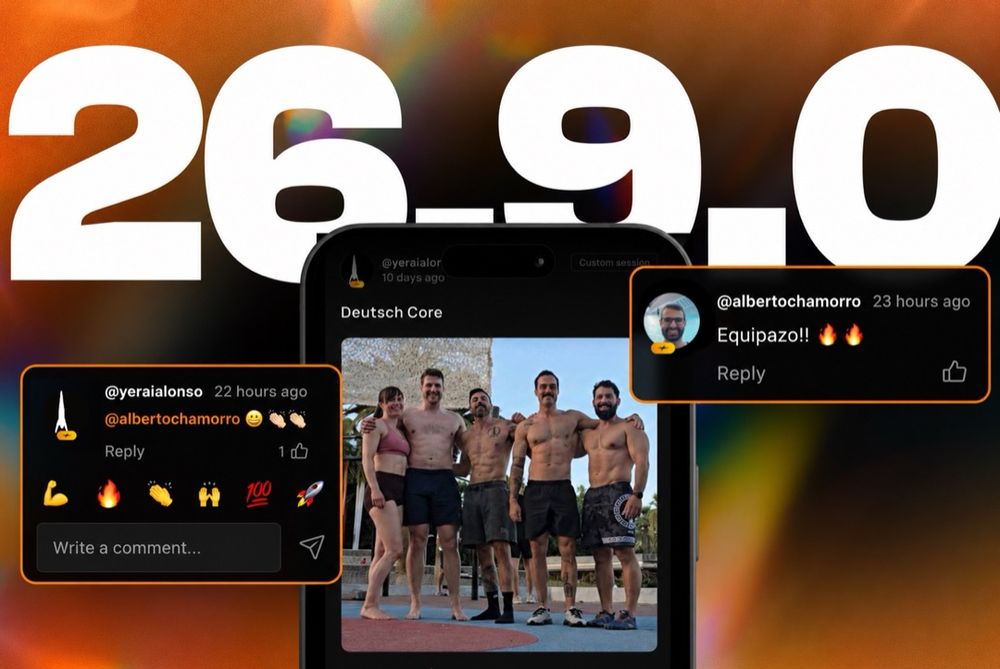
What's new in Calisteniapp v26.9.0: community comments, a new weighted calisthenics program with RPE, and improvements to the routine builder.