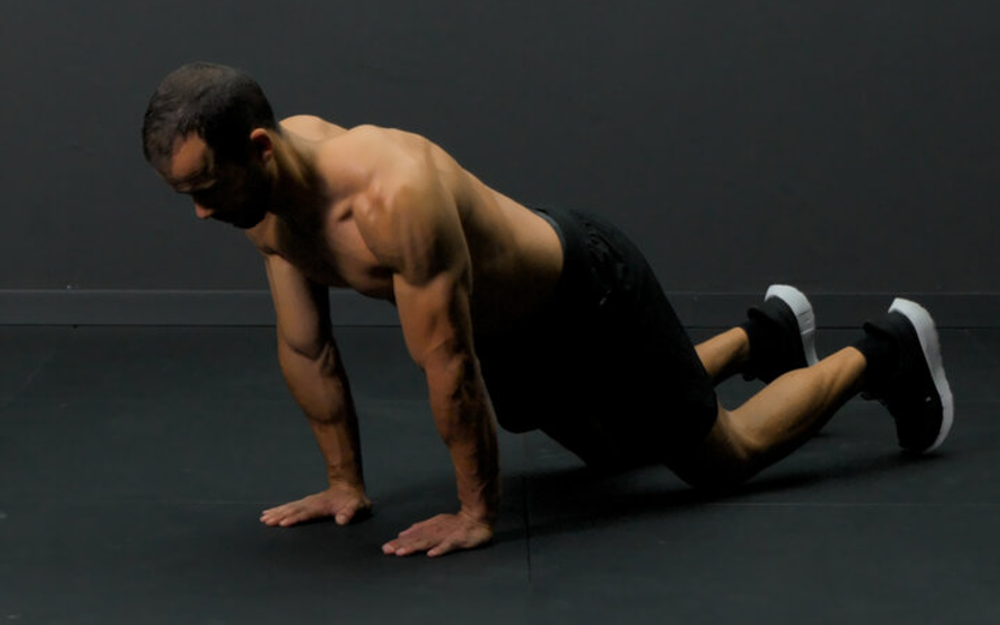
Wrist Exercises for Calisthenics: Mobility and Warm-Up Without Equipment
Discover the best wrist mobility and warm-up exercises for calisthenics. Rotations, progressions, and tips to protect your wrists during handstands and push-ups.
Discover how calisthenics can improve your running performance: which exercises to focus on, how to train for strength, and why it can help you run better.
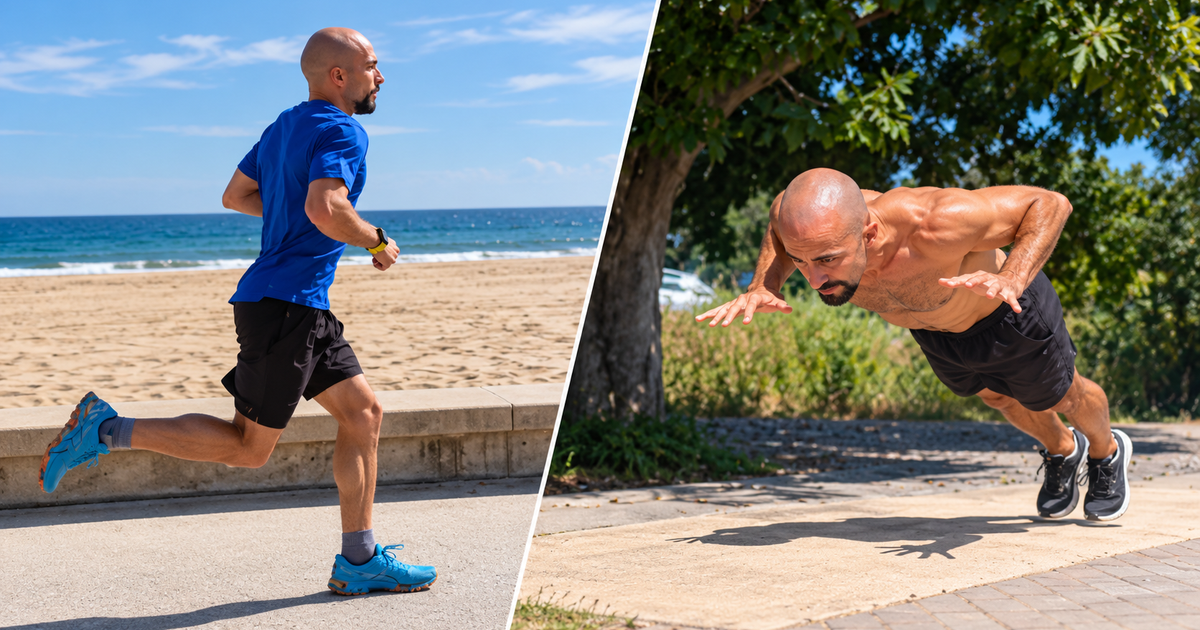
Running and calisthenics may seem like two very different disciplines, but they have much more in common than it might seem. Both require little equipment, offer plenty of freedom to train almost anywhere and, ultimately, are based on something as simple as moving and controlling our own body in space.
But the relationship between the two goes beyond convenience. If you run regularly, strength training can help improve your running performance, and calisthenics is one of the tools we can use to achieve this.
In this article, we'll look at what calisthenics can offer runners, which muscle groups we should work, and, above all, which types of strength may be most useful if our goal is to run better.
Our running performance depends on various physiological and biomechanical factors.
You may have heard of VO₂ max or lactate thresholds. These are important factors and are developed primarily through running training itself.
But there is another particularly interesting concept when we talk about running performance: running economy.
Running economy is, in simple terms, how efficiently we use energy when we run. In other words, how much energy we need to maintain a given speed.
This means that, between two people with similar aerobic capacity, the one with better running economy will be able to run faster using the same amount of energy.

Barnes, K. R. & Kilding, A (2015)
And this is where strength training can be especially useful.
Improving our ability to produce force and power can make each stride feel like less of a relative effort. In addition, strength work can also help with much more explosive actions, such as accelerating, tackling a hill or sprinting at the end of a race.
Calisthenics allows us to work on these abilities by lifting our body and adapting the exercises to our level.
Although when we think of running, our legs are probably the first thing that comes to mind, running involves practically our entire body.
So, if we want to use calisthenics to complement our running training, we shouldn't focus solely on the lower body; we should also work the core and upper body.
Obviously, when it comes to running, the lower body plays a leading role.
The glutes, quadriceps, hamstrings and calves are constantly involved in producing force and maintaining joint stability while running.
The advantage of calisthenics is that we can work these muscle groups without needing machines or lots of equipment.
Exercises such as lunges, Bulgarian split squats, hamstring bridges or different variations of single-leg squats allow us to build a solid strength base.


As we progress, we can use more challenging exercises, such as the pistol squat or the skater squat, and adjust their difficulty by changing the amount of assistance, range of motion or stability, or by adding weight if needed.


We can also include jumping exercises with an aerial phase once we have a sufficient base and want to work specifically on power.
The goal isn't to choose one "perfect exercise for runners," but to have progressions that allow us to keep increasing our ability to produce force and power.
If you're just starting out and still need to build that foundation, the Calisteniapp beginner upper-lower body program can help you get started with adapted progressions before moving on to more challenging exercises.
Although the legs produce much of the force when running, they don't work in isolation.
Our core has to stabilize the torso and allow the forces generated by our arms and legs to be transferred efficiently as we run.
That's why core training isn't just about doing crunches.
We can train different functions with exercises such as variations of planks, side planks or back extensions.


A strong, stable torso helps us maintain body control when fatigue sets in and better manage the forces generated continuously with every stride.
The arms actively contribute to running and help counteract the rotational forces generated by the legs. The upper body and core therefore help stabilize the body as we move forward.
That's why it's important to work the upper body even when our main goal is to improve our running.
We can include pulling exercises such as rows or different variations and progressions of pull-ups and pushing exercises such as push-ups, dips or pike push-ups.


If your main goal is running, we don't need to make upper-body training the focus of our preparation, but we should maintain balanced development across the whole body.
So far, we've looked at which muscles and exercises we can work on, but there's something important we need to understand.
If we want to use strength training to improve our running performance, it's not enough to do a few leg and core exercises now and then.
How we train those muscles matters too.
Two forms of strength that are particularly useful for runners are maximal strength and power.
Maximal strength training uses exercises or progressions that are difficult enough to allow us to perform only a few repetitions. For example, progressions that let us do approximately 2 to 5 repetitions.
Power training, on the other hand, aims to produce force and speed. This includes, for example, different jumping exercises or exercises with flight phases, as well as more typical calisthenics exercises such as the Muscle Up or maximum-height jumping push-ups.


Why does this matter for running?
Because improving the contractile properties of the neuromuscular system and the elastic properties of structures such as tendons can help us produce the force needed for each stride while using a smaller percentage of our maximum capacity.
Put much more simply: if you can produce more force and power, the amount you need for each stride represents a smaller proportion of everything you are capable of doing.
And that can help improve our running economy.
This doesn't mean that all your training has to involve extremely difficult or explosive exercises.
More traditional strength training, using progressions that allow you to perform approximately 6 to 20 repetitions, is also important. It helps us build a solid foundation, maintain or increase muscle mass, and prepare our bodies to later handle more demanding strength and running workouts.
We don't need to choose one or the other. Ideally, we should use different forms of strength training depending on where we are in our training plan, our level, and our goals.
If you already have some training experience and also want to work on muscular endurance, the Elite Endurance program by Calisteniapp could be an option to complement endurance sports such as running. If you're just getting started with calisthenics, you can begin at a more accessible level with Intermediate Endurance.
If you've only been running until now, you don't need to start doing pistol squats, maximum jumps, and pull-ups on day one.
As with running itself, strength training needs to be progressive.
You can start with exercises adapted to your level and first prioritize good technique. From there, you can gradually increase the difficulty of the exercises and work on different types of strength.
For many people, two strength-training sessions per week can be a good starting point.
The important thing is to have a progression in place. Always doing the same exercises at the same difficulty will probably eventually lead to a plateau.
We'll also need to take into account the fatigue generated by each workout. For example, doing a demanding leg session right before a long run probably isn't the best idea.
Exactly how to schedule calisthenics and running sessions throughout the week will depend on our goals and priorities, so it's worth addressing separately.
Calisthenics doesn't have to be just a way to "strengthen your legs a little" if you're a runner.
Used well, it can help us work on maximal strength, power, muscle mass, stability, and body control: abilities that can contribute to better running performance.
We can strengthen our legs, develop a core that transmits force more effectively, and also work our upper body to build a strong, balanced physique.
And we can do it with very little equipment and practically anywhere.
That's why calisthenics and running can make a particularly interesting combination: both offer the freedom to train anywhere, require relatively little equipment, and are based on learning to move our bodies better and better.
If you want to start building strength with progressions adapted to different levels, you'll find programs in Calisteniapp that can help you start developing these abilities and complement your running training.
References:
Personalized quiz
Answer 7 quick questions and we will recommend the program that fits you best.

Isaac Brandão
Graduado en Educación Física (CAFYD) y entrenador especializado en calistenia y running. Creador del Método AthleticV, combina el entrenamiento de fuerza con calistenia y la carrera bajo un enfoque de Calistenia Híbrida para desarrollar fuerza, resistencia y una condición física completa mediante una planificación estructurada y progresiva, sin necesidad de ir al gimnasio.
Learn everything you need to know about calisthenics
Discover the best wrist mobility and warm-up exercises for calisthenics. Rotations, progressions, and tips to protect your wrists during handstands and push-ups.

Find out which supplements are worth taking if you train calisthenics (and which aren’t). Creatine, protein, caffeine, and more, backed by scientific evidence.
What's new in Calisteniapp v26.9.0: community comments, a new weighted calisthenics program with RPE, and improvements to the routine builder.