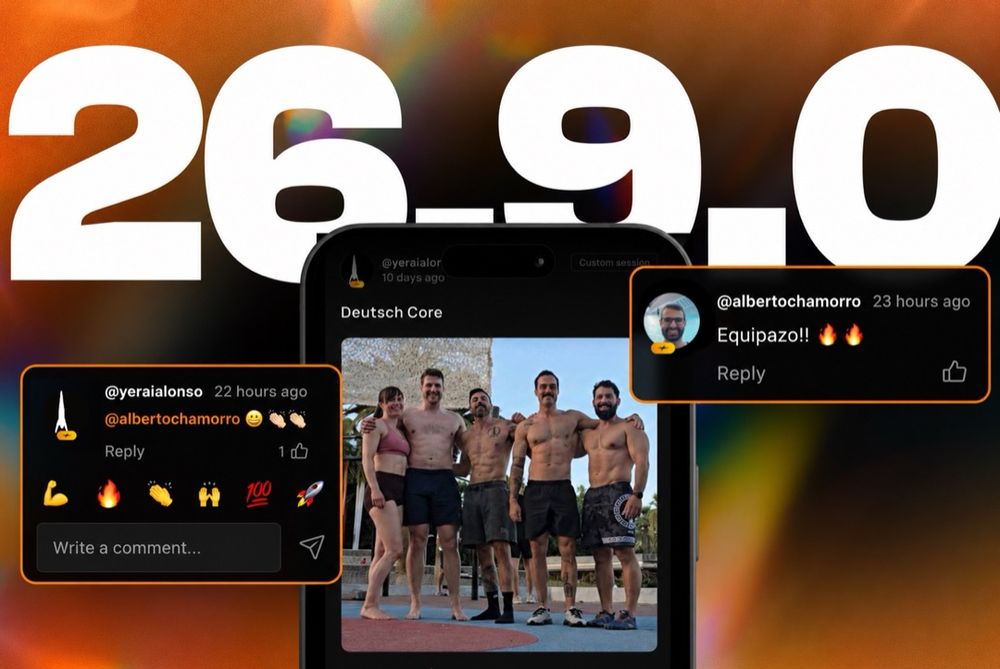
Latest Calisteniapp Update - v26.9.0
What's new in Calisteniapp v26.9.0: community comments, a new weighted calisthenics program with RPE, and improvements to the routine builder.
Discover the best triceps exercises in calisthenics to train at home without weights. A complete guide to building strength and size with bodyweight.
In calisthenics, the triceps often take a back seat to more eye-catching muscles like the chest or biceps. However, this muscle group is one of the main drivers of strength in all pushing movements. From push-ups to handstand push-ups, almost any pushing exercise depends heavily on the triceps’ ability to extend the elbow and stabilize the arm. So, if you want to improve your performance in calisthenics and build stronger arms, it is essential to train your triceps intelligently.
In this guide, you will find the best triceps exercises in calisthenics, organized according to how much emphasis the triceps receive in each movement. First, we will briefly look at triceps anatomy and function so you can understand how this muscle works. Then we will go through different exercises and variations, from basic movements to advanced exercises that isolate the triceps with bodyweight. Finally, you will find a simple triceps calisthenics routine and some common mistakes you should avoid when training.
The technical name of this muscle is the triceps brachii, since it is made up of three heads (tri-ceps): a long head, a lateral head, and a medial head; and it is also located in the arm (brachii). However, from here on, we will simply call it the triceps.

The triceps is located on the back of the humerus, crosses the elbow joint, and inserts into the ulna. Therefore, its main function is to straighten the arm; this movement is known as elbow extension.
This is the movement performed in triceps extensions and in multi-joint exercises such as the bench press and the shoulder press.

The lateral and medial heads of the triceps originate on the humerus. However, the long head originates on the scapula. So, besides the elbow, it also crosses the shoulder joint. Therefore, the long head also assists in shoulder extension (1).
This is the movement performed in exercises such as cable or dumbbell pullovers.

Understanding triceps anatomy and function is very important, because it allows us to identify which exercises are best for training it in calisthenics.
Before we start, the exercises below are organized according to the amount of emphasis placed on the triceps. Note: they are not organized by difficulty level. In the next section, you will find the exercises along with some progressions for beginners, intermediate, advanced, and pro athletes.
This level includes the basic calisthenics pushing exercises: push-ups, dips, and vertical push-ups (pike push-ups and handstand push-ups). These exercises mainly strengthen and develop the chest and shoulders, but they also involve the triceps to a great extent.
Below each exercise, you will find a blog article with a more detailed explanation.

Article: How to Do Perfect Push-Ups

Article: This Dip Variation Will Optimize Your Training

Article: How to Do Pike Push-Ups: Technique, Benefits, and Common Mistakes

Article: How to Do Handstand Push-Ups: 5-Step Tutorial
This level includes variations of the previous exercises that place more emphasis on the triceps.
For this level, I recommend reading the article on biceps exercises in calisthenics so you can better understand some of the concepts you will see below: Biceps Exercises in Calisthenics: Complete No-Weights Guide

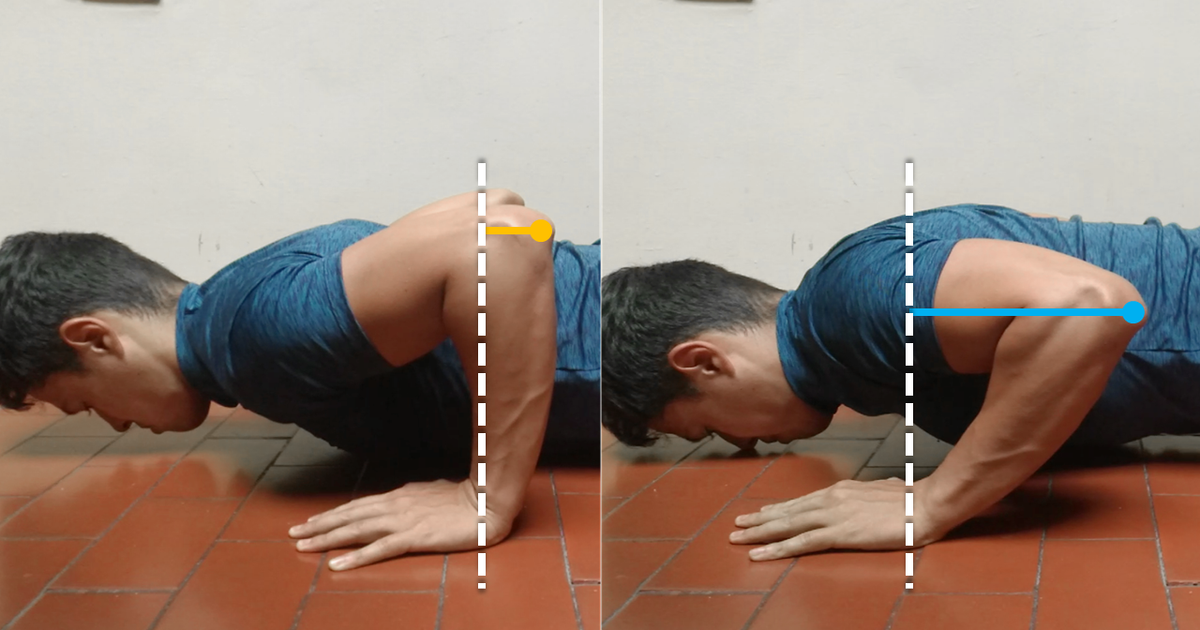
When you perform push-ups with your hands close together, there is a greater moment arm and a greater range of motion at the elbow, while the opposite happens at the shoulder joint. That is why diamond push-ups are recommended for working the triceps.
Note: The line of force is not completely vertical because horizontal forces also need to be taken into account. The most logical thing is to think that we push in a vertical line, but unconsciously we also push slightly outward (unless you consciously apply force inward). For this reason, the triceps are involved in conventional push-ups.

Another way to do push-ups with more triceps emphasis is by placing your hands a bit higher, roughly at neck height. The mechanics are exactly the same as in the previous case, only with the hands in a different position.
Think of this exercise as something in between regular push-ups and sphinx push-ups, which we will see later.
Note: I actually do not know what this push-up variation is called, if it has a name at all. I call it JM push-ups, in reference to the JM Press, a bench press variation that uses the same modification to work the triceps.

If you perform dips with a more upright, vertical torso, the elbows will travel backward, increasing the moment arm and range of motion at the elbow and, therefore, the load on the triceps.
As you can see, this is exactly the same foundation as JM push-ups, but applied to dips.

This level includes exercises that work the triceps directly. You could say these are the exercises that “isolate” this muscle in calisthenics.
Clearly, the stabilizing muscles are also very active in these exercises, but the main movement is elbow extension.

Sphinx push-ups are push-ups in which shoulder movement is reduced to a minimum, focusing only on elbow extension. This exercise is basically a French press (or skull crusher) with bodyweight.
Although sphinx push-ups are an excellent exercise, they have two major drawbacks: first, they are very difficult for beginners, and second, because they are performed on the floor, the range of motion is limited.
But both of these problems can be solved easily with the next exercise.

Triceps extensions are basically sphinx push-ups that can be performed on a bar, rings, or parallel bars.
This way, you can change the body angle to reduce the difficulty of the exercise. In addition, since the forearms are not stopped by the floor, you can perform elbow extension through its full range of motion.

This exercise is a triceps extension performed in a position close to a wall-supported handstand.
It is a very advanced exercise because you have to lift almost all of your bodyweight using only the triceps.
However, the advantage of this exercise is that elbow extension is performed with the shoulder in flexion. So the long head of the triceps is in a more stretched position, which seems to favor hypertrophy of this muscle according to different studies (2).

The impossible dip, like the sphinx push-up, is a dip variation in which you only perform an elbow extension movement.
This is another very advanced variation because you also have to support your entire bodyweight using only the triceps.
However, in order to execute the exercise this way, you have to lean your body backward, so the rear deltoid also has to apply a considerable amount of force.
If you want to learn this exercise, you can read the following article: Impossible Dip Tutorial - How to Do the Impossible Dip
You can also find a full Impossible Dip program in Calisteniapp: Impossible Dip Program
All the previous exercises are elbow extension exercises, but, as I explained at the beginning of the article, the long head of the triceps also participates in shoulder extension.

Yes, pull-ups work the biceps, but if you perform them with a shoulder-width grip, or narrower (as in neutral-grip pull-ups or chin-ups), you will bring your elbows in front of the body, emphasizing shoulder extension and, therefore, the long head of the triceps will participate as a stabilizer and assistant in this movement.
In fact, it is common for some beginners to feel soreness in the triceps after doing pull-ups in this style.

The front lever is a special case because this skill involves both isometric elbow extension and shoulder extension.
However, the problem with the front lever is that, at both joints, the triceps is in a fairly shortened position, so it does not have a strong capacity to produce force (length-tension relationship).
Therefore, it is not the most effective exercise if you are looking for maximum triceps hypertrophy.

If you want to learn more about the front lever, I recommend the following article: Front Lever: Complete Guide to Technique, Progressions, and Exercises

The dragon flag is very similar to the front lever, with the difference that the elbow is flexed and the shoulder is extended. Therefore, the triceps will be at a muscle length where it can produce more force.
If you want to learn more about the dragon flag, I recommend the following article: Dragon Flag in Calisthenics: Complete Guide with Exercises
Once we have reviewed all these exercises, let’s organize them according to each person’s level.
A very common mistake when some people want to work the triceps in isolation is that they do not focus on the elbow extension movement and, as a result, they do not isolate the triceps well.
This generally happens in sphinx push-ups. Because some people still do not have full body awareness, they end up doing a kind of JM push-up instead.
If this happens to you, use an easier progression and focus on moving only the elbow joint.
One mistake I sometimes see when someone is doing low bar triceps extensions is that they perform the exercise as if it were some kind of behind-the-neck shoulder press.
It is true that, depending on the technique, the head can end up below the bar, but remember that the movement is performed only through elbow extension.
This mistake is quite similar to the previous one. When performing triceps extensions, the elbows should point forward, not out to the sides. If this happens, there will be poor joint alignment, which could cause pain or even injury.
In addition, if you flare your elbows, you will probably also end up moving the shoulders, falling into the previous mistake.
To fix this, think about externally rotating the shoulders so that the elbows stay closer together and point downward.

Next, I am going to show you a basic triceps-focused routine for intermediate athletes:
3x5-10 Weighted dips4x8-15 Weighted diamond push-ups4x8-15 Low bar triceps extensionsThe routine consists of only three exercises:
The first is a vertical pushing exercise: weighted dips, although you can also do pike push-ups or handstand push-ups depending on your level.
The second is a horizontal pushing exercise with emphasis on the triceps: weighted diamond push-ups.
And the third is an isolation exercise for the triceps: low bar triceps extensions.
Remember that in Calisteniapp you can find routines and programs to train your triceps and other muscle groups, adapted to your level and the equipment you have available.
Download it and start training with structure.
Landin, D., & Thompson, M. (2011). The shoulder extension function of the triceps brachii
Maeo et al. (2023). Triceps brachii hypertrophy is substantially greater after elbow extension training performed in the overhead versus neutral arm position.
By: Alex Belt
Personalized quiz
Answer 7 quick questions and we will recommend the program that fits you best.
Learn everything you need to know about calisthenics
What's new in Calisteniapp v26.9.0: community comments, a new weighted calisthenics program with RPE, and improvements to the routine builder.
Want to train your lower trapezius? Improve your posture and technique in pull-ups and handstands. No equipment, with progressions
Find out how much water you need if you train calisthenics, when to drink it, and how hydration affects your strength and performance. A complete guide.