How to improve your technique for Weighted Calisthenics
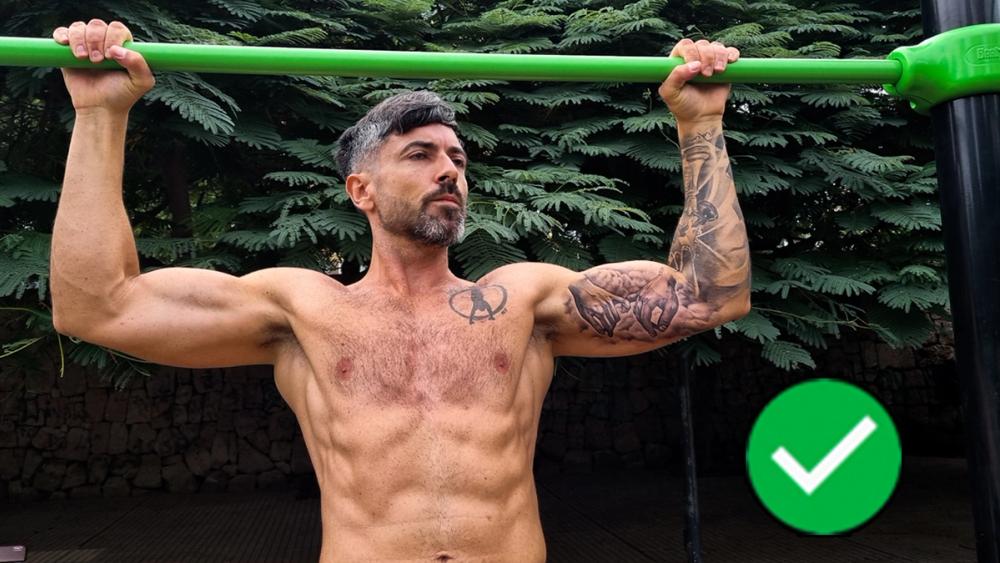
In this article we are going to explain some small tricks and technical details that will allow you to move more weight in the main exercises of weighted Calisthenics, specifically in weighted pull-ups, weighted dips and weighted muscle up.Weighted dipsThe first piece of advice is regarding the position of the head and torso. We tend to think that for a dip to be completely strict, you have to have a straight body, perpendicular to the ground, and a straight head looking to the front. But in weighted dips this is not the case. In order to get the most out of the movement and lift the most weight, you must lean your torso forward, bringing your chest to a position more parallel to the ground, with your eyes looking down as well. This will allow you to have a more comfortable lever for your pectoral and obtain its maximum strength. Weightlifters even do an abdominal crunch on the way down to try to flex their torso a bit more, and release this crunch on the way up so they get a little "push" from the release. This boost is minimal, but in situations where you are working close to your 1RM it can be very helpful. Another point to consider is the placement of the weight. You must try to keep it from not being too low, so that it does not cause you to swing more than necessary, and you must also squeeze it between your legs, so that it moves as little as possible. Having the weight pinched between your legs will help you to take advantage of the inertia that is generated when you go down (the weight goes backwards), so that it later helps you to "bounce" up.Pull upRegarding pull-ups, the first thing we are going to do is choose between prone grip (palms facing forward) or supine grip (palms facing you). This is more a matter of personal preference and your specific morphology, just choose the one that is most comfortable for you and notice that you can exert more force. In competition both grips are valid. Normally with the prone grip the start of the movement is a little more difficult but it is easier to finish it, and with the supine grip the start is facilitated but the final part is difficult. Another detail to take into account is that with the prone grip it is recommended to establish a slightly wider than normal separation of the hands, and with the supine grip a slightly narrower separation than normal. A technique that can help you a lot is the so-called "leg drive". It consists of applying a small movement with the legs just as you start to climb, so that it helps you slightly. You have to be very careful with this leg drive as it is allowed in competition but it has to be very light. If you do it by bending your knees or in a too obvious way, they will judge the repetition as null.